I hope this email finds you well. Please let me cordially invite you to the Inaugural Conference hosted by the Australian Society for Asian Humanities, on 3 & 4 July 2026.
This two-day conference features a full range of events to acknowledge and reflect on the fields of Asian humanities, including three keynotes, two plenary panels, and art and food in Sydney, a pivotal gateway for Asia in Australasia.
We are particularly interested in papers from Southeast Asia, South Asia and West Asia (the Middle East), Central Asia, as well as East Asia. Postgraduate students are by all means welcome!
Please do let me strongly encourage you to submit a panel or individual paper proposal to celebrate the deep richness of studies on Asian humanities!
The conference will be held in Madison, Wisconsin, USA in August 2024. It is being co-hosted by the American Association of Teachers of Japanese (AATJ) and the Canadian Association for Japanese Language Education (CAJLE)
Proposals for paper presentations, poster presentations, and interactive workshops can be submitted until Tuesday, Oct. 31, 2023, 11:59 pm US Central Time. Please check out details at Call for Papers
The situation and challenges of children in South Korea who are connected to Japan
韓国における日本と繋がる子どもたちの状況と課題
The seminar will be conducted in Japanese.
※本セミナーは日本語で行われます。
For our fifteenth Japanese education seminar with UNSW, exploring the theme of raising Japanese-speaking children in Australia, we have invited for Keiko Sakurai (Inha University), president of Korea Association of Heritage Japanese Language as well as three of her fellow committee members.
【Message from Korea Association of Heritage Japanese Language】
South Korea is now transforming into a multicultural society. In the seminar, we will discuss the situation of children with connections to Japan (Keishogo children), practices and initiatives for Japanese education at home and outside home, as well as issues and challenges associated with Japanese education, based on our research.
We have heard that there is a need to develop teaching materials, classroom activity plans and teaching methods suited to local conditions. Hence, our research group joined with self-help groups active in South Korea and formed a project team, compiling a collection of ideas for classroom resources. We would like to introduce them to you and invite you to compare them.
The relationship between Japan and South Korea has not been easy to resolve, and educating children about the history between the two nations is inevitable. It is a factor in forming the identities of these children, who will be a bridge between the two countries. Here, we would like to introduce the teaching method that our research group conducted in both Japan and South Korea on the theme of the Joseon missions to Japan. Australia and South Korea have some differences, but there must be many common issues too. In the seminar, we would like to consider such issues in relation to Keishogo education in these two countries and beyond.
Congratulations to the winners of the JSANZ Japanese Firsts Awards 2022. There are 14 awards in all and there were many excellent nominations this year so if the person you nominated did not get chosen this time, please try again next year as we are keen to showcase all the amazing people working hard to make the language learning journey a great experience for everyone.
Most Dedicated Japanese Language Lecturer: Yoshiko Lowry, Ara Institute of Canterbury
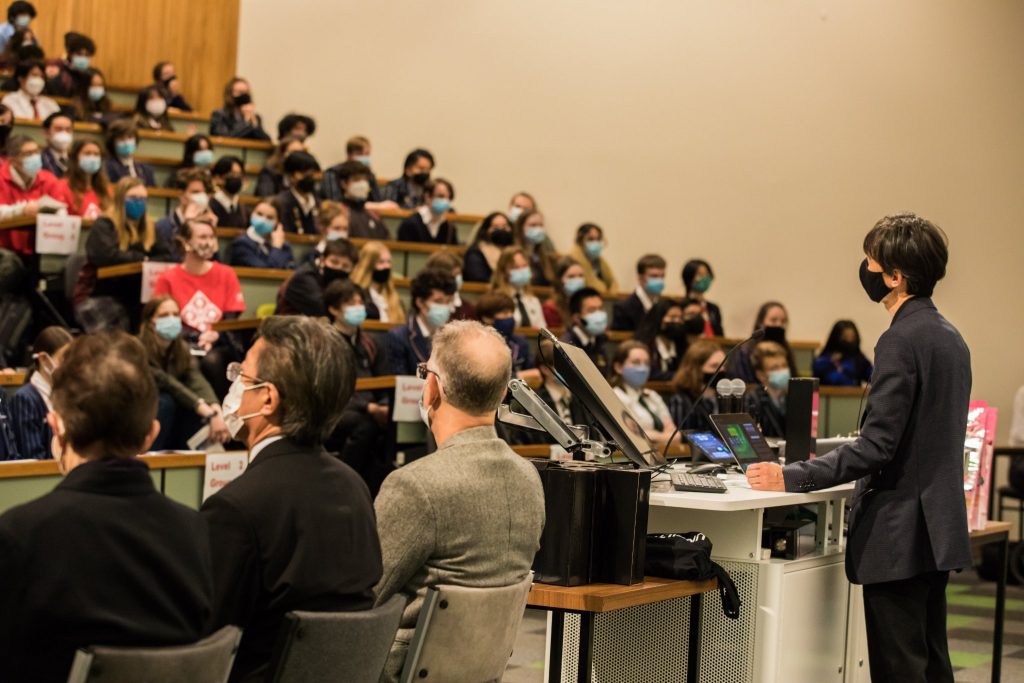
The 9th NCEA Japanese Workshop attracted over 400 secondary students from 16 Canterbury schools on 9 June.
This workshop is a joint collaboration by the UC Japanese programme and the Canterbury Network of Teachers of Japanese, and it is the largest of its kind on Japanese language education in Oceania.
The day started with a warm welcome by Professor Peter Field, and greetings by Mr Tsuguyoshi Hada, the Director of the Consular Office of Japan. It was followed by a special talk by Ms Krystal Boland, a UC graduate and teacher at Ellesmere College, on her encounters and experiences with Japan and the Japanese language.
The secondary school students took part in three intensive language sessions joined by 25 UC students acting as teaching assistants and mentors. Year 13 students had a special Tuakana–Teina session where they interviewed the UC students on their motivation and strategies for learning Japanese in Japanese. In the closing session, all participated in a lucky dip, with prizes donated by the Consular Office of Japan and Education Perfect, followed by an energised, collaborative dance-off to the Japanese hit song The world is smiling at you.See the 2021 dance video here. https://youtu.be/WztduhXbtxc
The workshops promote interactions between secondary schools and the UC Japanese programme, to enhance and strengthen the Japanese learning community. There was overwhelmingly positive feedback from both the students and staff.
The Japanese programme is grateful to all the secondary school teachers who made a huge effort to make this event happen.
Greetings from the Japanese Literature Publishing Project (JLPP)
Hello, my name is Yasuhiko Ogawa, Chief Director of JLPP (Japanese Literature Publishing Project).
The JLPP is a project sponsored by the Japanese Agency for Cultural Affairs to promote awareness and appreciation of contemporary Japanese literature.
https://www.jlpp.go.jp/
In the hopes of fostering a new generation of translators of Japanese literature, we have thus far held JLPP International Translation Competitions five times since 2010, translation workshops, and international symposiums.
We are pleased to announce that the 6th JLPP International Translation Competition (English and Spanish) is now underway.
We select three prize winners in each of the target languages, and we award not only prize money but also hold supportive programs for their first step as literary translators.
Some of the previous winners have become active translators of Japanese literature in the world’s publishing community.
For more information, please visit the following website.
As you may have heard the Japan Foundation Sydney is running an online Talent Contest, J-Talent for the Oceania Region.
https://jpf.org.au/events/whats-your-j-talent/
Participants are encouraged to showcase their Japan-related talents, including Japanese language from the below four categories.
Japanese Language
Lifestyle
Traditional Arts and Culture
Pop Culture
We invite you and your students to enter the contest, particularly the Japanese Language category and have fun with the Japanese Language for the chance to win some great prizes! Entries can be up to 2 minutes in length and individual, group and family entries are strongly encouraged.
A fifth free topic (Your choice) has been added to the four topics to make it easier for everyone to enter.
There are two points regarding the Japanese language, which may appear overwhelming however please be aware that the weighting of this criteria is much smaller than content and video. The focus is squarely on having fun with language, so please encourage all of your students to not be shy and have a try!
If you or your students don’t feel comfortable entering the language category, we warmly welcome you to enter one of the other categories (lifestyle, traditional arts and culture, pop culture) and show off your hidden Japan-related talents!
We have added a fun sample video (Japanese) of 30 seconds to help get some ideas flowing (however entries can be of up to 2 minutes). Please see it here:https://youtu.be/jEpfb28EPBo
As mentioned in the guidelines, Japanese language audio should be accompanied by English subtitles for the enjoyment of all. To make this easier, we have added a ‘how-to’ tutorial video here:https://youtu.be/9ZKoRKxqwdsCaptions
We hope this helps inspire you and/or your students to enter this fun contest and unleash their #JTalent.
Submissions are being accepted until October 31, so there’s plenty of time to enter!