We have uploaded the video of the winning speech in the 2026 contest. You can see it on this link
2026 JSANZ Tertiary Speech Contest Winners
The 2026 speech contest winners have been decided. Thanks go to all the participants and everyone who helped with the pre-judging and prepartion of the videos.
As always it was a very close contest and the winning speeches were thought provoking and well presented. The 2026 winners are:
1st Place Wells Wall (Victoria University of Wellington) 「日本語の効果的な勉強方法」
2nd Place: Joel Taylor (University of Waikato) 「留学の価値」
3rd Place: Shelly Liang (Victoria University of Wellington) 「外国語が「上手になる」とはどういうことか」
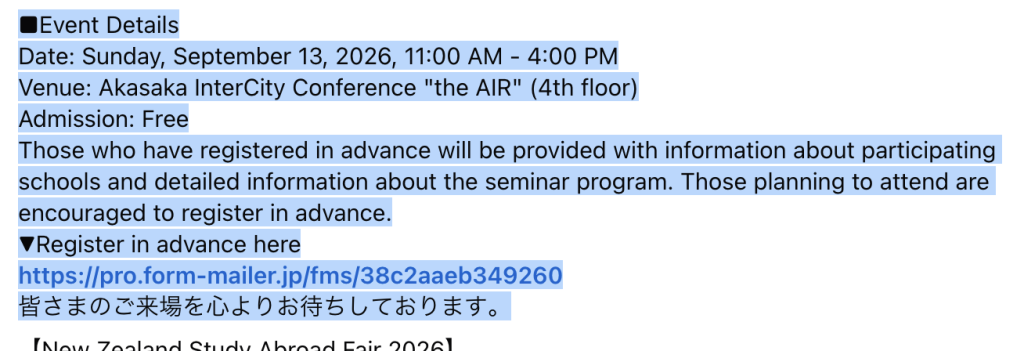
New Zealand Study Abroad Fair, Asakusa


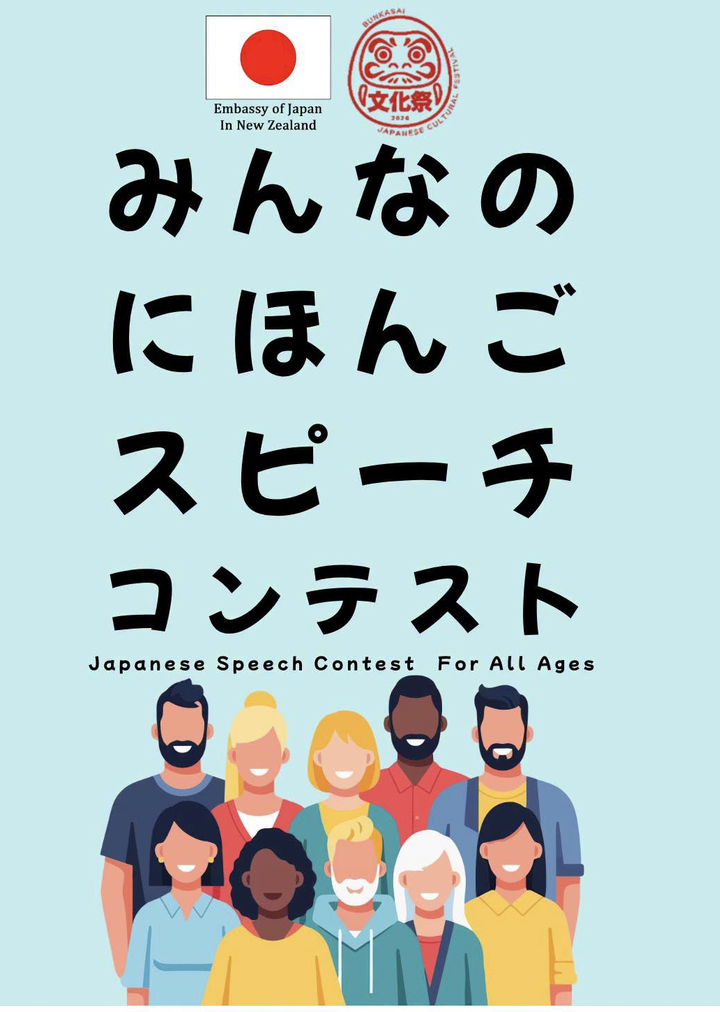
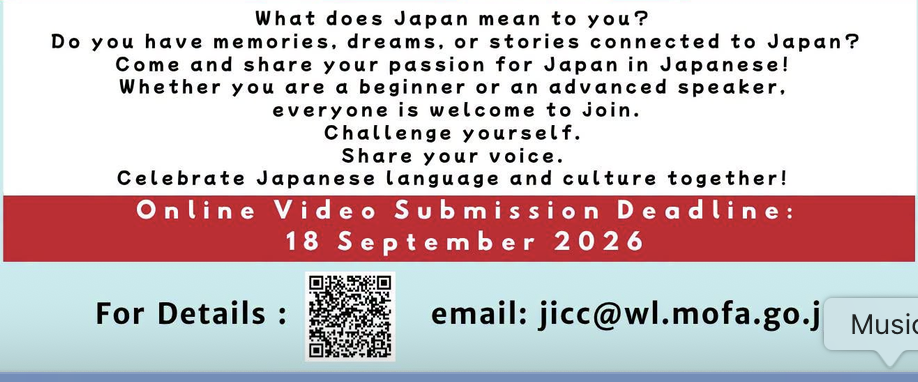
Japanese Language Speech Contest
JLPT December 2026
| Applications are now open for the December 2026 Japanese Language Proficiency Test (JLPT). Test Date: Sun 6 December Venue: University of Auckland Application Close: Tue 25 August |
Kakogawa Sister City Visit
8月17日、オークランド市と姉妹都市関係にある加古川市から8名の生徒が総領事館を訪問しました。箕谷総領事から、総領事館の業務について説明するとともに、加古川市とオークランドとの姉妹都市交流の更なる発展について期待を述べました。また生徒の皆さんから、ニュージーランド滞在の印象についてお話をお聞きしました。
On 17 August, eight students from Kakogawa City, a sister city of Auckland, visited the Consulate-General of Japan. Consul General MINOYA introduced the work of the Consulate-General and expressed his hope for the further development of sister-city exchanges between Kakogawa and Auckland. The students also shared their impressions of their stay in New Zealand.
2026 JSANZ Tertiary Speech Contest
If you haven’t got your application in yet you still have until 31 August.
We have seen thoughtful and uplifting speeches over the years and are still surprised each time by the talent of our tertiary students.
Guidelines
Conference news
Dear Colleagues,
Greetings from Wellington, NZ!
I hope this email finds you well. Please let me cordially invite you to the Inaugural Conference hosted by the Australian Society for Asian Humanities, on 3 & 4 July 2026.
This two-day conference features a full range of events to acknowledge and reflect on the fields of Asian humanities, including three keynotes, two plenary panels, and art and food in Sydney, a pivotal gateway for Asia in Australasia.
We are particularly interested in papers from Southeast Asia, South Asia and West Asia (the Middle East), Central Asia, as well as East Asia. Postgraduate students are by all means welcome!
Please do let me strongly encourage you to submit a panel or individual paper proposal to celebrate the deep richness of studies on Asian humanities!
Warmest wishes,
Shin Takahashi
2025 Tertiary Japanese Language Speech Contest Guidelines
Japanese Studies Aotearoa New Zealand
Tertiary Japanese Language Speech Contest 2025
Guidelines
The eleventh Japanese Studies Aotearoa New Zealand (JSANZ) Tertiary Japanese Language Speech Contest will be conducted according to these guidelines.
1. CONTEST BACKGROUND
The aim of the contest is to encourage learners who are studying Japanese to showcase their language skills in a challenging context.
2. CONTEST FORMAT
Theme of Speech
The theme of this year’s speech competition is open to the contestants to decide.
Length of Speech (Time Limit)
4 – 5 minutes + time for two questions and replies.
Q&A
After delivering their speech, contestants will be asked up to two questions by the teaching staff of the institution, based on the content of their speech. This should be included in the video (see below) in addition to the speech.
3. APPLICATION
- Applications open on 1 June and close on 31 August.
- Applications are limited to a maximum of two contestants from each tertiary institution. It is expected that finalists will be chosen through a rigorous selection process (e.g. internal speech contest) to maintain the high standard of the national contest.
NB the following instructions (iii. to xi.) may be modified if Covid-19 related restrictions are in place – in this case liaise with your lecturers.
- The speech should be digitally video-recorded with an audience of at least 10 people.
- Include the upper half of the body of the speaker in the video capture, including hands and lectern – if used. The winner’s speech will be uploaded to YouTube so please be mindful of the background. Ensure that the speaker’s voice is clearly recorded. The five winners’ speeches from each year since 2015 can be viewed on the JSANZ YouTube Channel.
JSANZ YouTube Channel: https://www.youtube.com/channel/UCmT6U-nVHiKFPNkPFsy_uSg
- The instructor does not need to be in the video when s/he asks questions. However, their voice should be clearly recorded.
- When the video is ready with your entry:
- Upload your video to YouTube. Use the family name of the contestant as the title for the video clip. Do not add the name of your institution.
- Click the arrow next to Upload, then press Video Manager.
- Go to the uploaded video, press Edit and change the Privacy Settings to Unlisted. Press Save.
- Share the link to jsanzaotearoa@gmail.com
- Note that you need a Google and Google+ account to create a YouTube account.
- The teaching staff from each tertiary institution are responsible for emailing a separate application for each candidate to the organizers, jsanzaotearoa@gmail.combefore 5:00 pm 31 August. Include ALL of the following:
- The relevant YouTube link.
- An application form with a speech summary (100-150 words) in English and the applicant’s declaration forms.
- The teacher’s declaration form.
- A separate email application must be made for each applicant (maximum of two candidates per institution). Only applications via email attachments will be accepted.
- Please write in the subject line “JSANZ Tertiary Japanese Speech Contest Application.”
- Late entries will not be accepted.
- If you have not received a confirmation email within one week of submitting your application, please contact the organizer by email [see Section 10 Enquiries].
4. PROCEDURE FOR SELECTION
- The judges will blind-mark (i.e. judges will not be told the institution of the applicants) each video, using a selection criteria form provided, and report to the organizer by 20 September.
- Contestants will be notified of the results by 30 September.
5. ELIGIBILITY
- This contest is open to individuals aged 17 or above who are enrolled in undergraduate courses at a tertiary institution in New Zealand. NB students who completed their qualification in Semester 1, 2025, are also eligible to apply. Postgraduate students are not eligible.
- Previous first prize winners in the JSANZ speech contest may not take part.
- Native or near native speakers of Japanese may not take part.
Japanese Studies Aotearoa New Zealand
Tertiary Japanese Language Speech Contest 2025
Guidelines
The eleventh Japanese Studies Aotearoa New Zealand (JSANZ) Tertiary Japanese Language Speech Contest will be conducted according to these guidelines.
1. CONTEST BACKGROUND
The aim of the contest is to encourage learners who are studying Japanese to showcase their language skills in a challenging context.
2. CONTEST FORMAT
Theme of Speech
The theme of this year’s speech competition is open to the contestants to decide.
Length of Speech (Time Limit)
4 – 5 minutes + time for two questions and replies.
Q&A
After delivering their speech, contestants will be asked up to two questions by the teaching staff of the institution, based on the content of their speech. This should be included in the video (see below) in addition to the speech.
3. APPLICATION
- Applications open on 1 June and close on 31 August.
- Applications are limited to a maximum of two contestants from each tertiary institution. It is expected that finalists will be chosen through a rigorous selection process (e.g. internal speech contest) to maintain the high standard of the national contest.
NB the following instructions (iii. to xi.) may be modified if Covid-19 related restrictions are in place – in this case liaise with your lecturers.
- The speech should be digitally video-recorded with an audience of at least 10 people.
- Include the upper half of the body of the speaker in the video capture, including hands and lectern – if used. The winner’s speech will be uploaded to YouTube so please be mindful of the background. Ensure that the speaker’s voice is clearly recorded. The five winners’ speeches from each year since 2015 can be viewed on the JSANZ YouTube Channel.
JSANZ YouTube Channel: https://www.youtube.com/channel/UCmT6U-nVHiKFPNkPFsy_uSg
- The instructor does not need to be in the video when s/he asks questions. However, their voice should be clearly recorded.
- When the video is ready with your entry:
- Upload your video to YouTube. Use the family name of the contestant as the title for the video clip. Do not add the name of your institution.
- Click the arrow next to Upload, then press Video Manager.
- Go to the uploaded video, press Edit and change the Privacy Settings to Unlisted. Press Save.
- Share the link to jsanzaotearoa@gmail.com
- Note that you need a Google and Google+ account to create a YouTube account.
- The teaching staff from each tertiary institution are responsible for emailing a separate application for each candidate to the organizers, jsanzaotearoa@gmail.combefore 5:00 pm 31 August. Include ALL of the following:
- The relevant YouTube link.
- An application form with a speech summary (100-150 words) in English and the applicant’s declaration forms.
- The teacher’s declaration form.
- A separate email application must be made for each applicant (maximum of two candidates per institution). Only applications via email attachments will be accepted.
- Please write in the subject line “JSANZ Tertiary Japanese Speech Contest Application.”
- Late entries will not be accepted.
- If you have not received a confirmation email within one week of submitting your application, please contact the organizer by email [see Section 10 Enquiries].
4. PROCEDURE FOR SELECTION
- The judges will blind-mark (i.e. judges will not be told the institution of the applicants) each video, using a selection criteria form provided, and report to the organizer by 20 September.
- Contestants will be notified of the results by 30 September.
5. ELIGIBILITY
- This contest is open to individuals aged 17 or above who are enrolled in undergraduate courses at a tertiary institution in New Zealand. NB students who completed their qualification in Semester 1, 2025, are also eligible to apply. Postgraduate students are not eligible.
- Previous first prize winners in the JSANZ speech contest may not take part.
- Native or near native speakers of Japanese may not take part.
6. MARKING CRITERIA The marking criteria are as follows:
| Presentation | 30% (e.g. delivery, manner, memorization, attitude, length) |
| Content | 40% (e.g. coherence, cohesion of ideas, originality, intention, message, impact) |
| *Language (refer to 6.ii below) | 25% (e.g. fluency, pronunciation, grammatical complexity/flexibility, range of language, accuracy) |
| Q & A | 5% (e.g. communication competence, appropriateness of response) |
- The speech must be the original work of the contestant. The degree of assistance given by teachers or by Japanese native speakers should be limited to no more than correcting grammatical errors or making minor alterations.
- *Language criterion: Based on the contestant’s Language Background Declaration (see Student Application Form), a maximum of 5 marks may be deducted in the language category.
- PowerPoint slides and props (e.g. puppets, objects etc.) may not be used.
- Use of a lectern is optional.
- Post-speech questions should be straightforward, and must not be known to the contestants in advance.
- All speech presentations are better when memorized: Contestants should NOT read their speeches. Contestants may refer to their notes, however excessive consultation will result in marks being deducted.
- Videos should show the upper half of the body of the presenter, not only the face. (If only the face is shown in the video, it is easy to assume the presenters are reading their cue cards if they are constantly looking down.)
- Showing the audience in the video is optional.
- The quality of sound should be carefully checked before recording, and before submitting the video files.
- Please be mindful of the speech time limit. Judges may decide not to take into account anything beyond the time limit.
- Aggregates of marks from all judges will determine the place allocated to each contestant in the order of 1st, 2nd, and 3rd. In case of a draw, the judges will determine the outcome through discussion. The judges’ decision is final and no correspondence will be entered into. The content of the judges’ discussion is not open to the public at any time.
7. PRIZES and Follow-up
All contestants will receive a participation certificate. A prize will be awarded to the winners. Nisuikai, kindly supports the following prizes.
First prize: Travel voucher for a trip to Japan $2500 equivalent
Second prize: Domestic travel voucher $600 equivalent
Third prize: Domestic travel voucher $400 equivalent
Participants who do not place in the top three awards will receive a participation prize in the form of a Prezzy card. The prize value will be determined by the number of participants.
JSANZ hopes that the winners are willing to publicize their achievements and help promote Japanese language education in NZ:
- The first prize winner will be asked to add English subtitles to their speech recordings and then upload them to the JSANZ YouTube Channel, so that online audiences with little or no Japanese can also enjoy the speeches. Technical support will be provided.
- The first prize winner may also be asked to post a video message to the JSANZ Facebook page, as well as writing a short report on his or her experiences in Japan, which will be posted to the JSANZ website, sent to our sponsors and to other relevant media.
- The first, second and third prize winners may be asked to visit the offices of our official sponsors, either in-person or using video-conference.
8. Timeline
1 June: Application opens
31 August: Application closes
30 September: Notification of winners
9. Information on previous contests
JSANZ YouTube Channel / JSANZ Speech Contest Winners
https://www.youtube.com/channel/UCmT6U-nVHiKFPNkPFsy_uSg
10. Enquiries
Dr Shinnosuke Takahashi
Chairperson of the JSANZ Speech Contest Committee
Victoria University of Wellington
E: shin.takahashi@vuw.ac.nz
Ms Yoshie Nishikawa
JSANZ Speech Contest Committee
Victoria University of Wellington
E: yoshie.nishikawa@vuw.ac.nz